What's Happening in our Forest?...
What's Happening in our Forest? |
New VAB Lineal Grading Optimizer at Sexton Lumber...
New VAB Lineal Grading Optimizer at Sexton Lumber |
Eltec harvester at work in the Quebec forest...
Eltec harvester at work in the Quebec forest |
USNR log loader minds log gap, improves throughput...
USNR log loader minds log gap, improves throughput |
Mill profiles
May 16, 2013, Vancouver, B.C. – International Forest Products reached an agreement to acquire the assets of Keadle Lumber Enterprises of Thomaston, Georgia. Keadle is a producer of quality southern yellow pine lumber and has been in business since 1947. The mill produces 80 million board feet on a one - shift basis. Interfor intends to increase the mill's kiln capacity and add a second shift to the operation, as market conditions improve, bringing production to an annual rate of 160 million board feet. The Keadle mill is about 75 miles west of Interfor's recently acquired mill at Eatonton, Georgia and is part of the Company's strategy to grow its presence in the U.S. Southeast. The transaction will be financed from Interfor's existing lines of credit, which were recently expanded and extended. The transaction is subject to final documentation and Board approval and is expected to close prior to the end of the second quarter.
May 14, 2013, Surrey, B.C. – Brunette Machinery Company (BMC) announced a change in ownership at Brunette Industries, and have partnered with Murray Latta Progressive Machine Inc. (MLPM) of Surrey, B.C.The companies have purchased the assets of Brunette Industries Ltd. (Head office in New Westminster, B.C.), Brunette Industries Ltd. (Prince George Div.), Brunette Industries Inc. (Atlanta, G.A.), and BDR Machinery Ltd. (Toronto, Ont.). All branches will now operate under the new company name Brunette Machinery Company Inc. (BMC).The company will now have access to MLPM's 60,000 SF manufacturing facility, expertise, and equipment which will help Brunette increase manufacturing capabilities, and enable expanded focus on product development, and customer service.MLPM has been a custom machinery manufacturing, planer mill equipment and parts distribution, millwrighting and machinery moving throughout North America since 1918. Branch details and locations can be found on Brunette’s website, www.brunettemc.com.
Optimization
Planer tech continues to advance
Like all industries, forestry is becoming increasingly high-tech, with new advancements “coming down the pipe” on an ongoing basis.
The latest version of a business software for lumber and wood products manufacturers offers customization tools and an improved user interface.
Drying
May 16, 2013, Vancouver, B.C. – International Forest Products reached an agreement to acquire the assets of Keadle Lumber Enterprises of Thomaston, Georgia. Keadle is a producer of quality southern yellow pine lumber and has been in business since 1947. The mill produces 80 million board feet on a one - shift basis. Interfor intends to increase the mill's kiln capacity and add a second shift to the operation, as market conditions improve, bringing production to an annual rate of 160 million board feet. The Keadle mill is about 75 miles west of Interfor's recently acquired mill at Eatonton, Georgia and is part of the Company's strategy to grow its presence in the U.S. Southeast. The transaction will be financed from Interfor's existing lines of credit, which were recently expanded and extended. The transaction is subject to final documentation and Board approval and is expected to close prior to the end of the second quarter.
The objective of this discussion is to summarize recent trends related to industrial kiln drying with especial emphasis on the drying of softwood dimension lumber. According to an relatively recent report, between 1995 and 2007 the number of softwood sawmills in the United States and Canada was reduced by 24.5%. The same authors predicted that the prospects for the lumber industry in the next few years are uncertain due to over capacity, cyclical downturn of the housing market and the mountain pine beetle epidemic that is currently devastating most of the pine in Western Canada. Another cause for concern for the wood industry is the apparent steady decline in student enrolment in disciplines related to wood technology. Despite these pessimistic predictions, some analysts believe that once the over-supply issue is resolved and the lumber market returns to its normal course, the sawmills that managed to succeed in those difficult times will be in excellent conditions for years to come. They will fulfill the demand for lumber products for traditional residential markets, for growing remodelling markets and for the potential expansion of the non-residential markets. IncentivesIn addition to strong economic activity, other components that will fuel future trends in kiln drying technology include, skill set development; increased pressure from environmental groups; growing customer demand for better quality; growing pressure for reducing costs; increased competition from other materials; challenges associated with current wood species; utilization of alternative species; potential new products and applications; increased stringent regulations regarding product performance; and technology adaptation and innovation. Global market is a clear reality. Companies must be aware of the subtle changes in public perception and react accordingly to the new trends related to public demand. Educational institutions must work closely to industry leaders in the design of the curricula to prepare future generations so that new approaches to wood manufacturing can be developed. It has been argued that the introduction of new control systems for dry kilns could reduce the average energy consumption by 18%, and if such energy efficient systems were installed in 50% of the dry kilns operating in Canada that use fossil fuels, then the energy decline would be equivalent to decreasing by 332 kT per year the amount of CO2 released into the atmosphere. Thus, there is great potential for saving energy and at the same time minimize the impact on the environment. In addition to the increase in energy costs, labour costs have also been increasing since lumber producers must constantly compete with other industrial sectors to attract skilled workers. Increased demand for high quality has spread to all types of wood products. With the advent of home centres, customers can inspect the product before buying and therefore be selective regarding their choices. Customers aware of potential degrade risks associated with inadequate moisture are demanding stringent specifications in the purchase orders. Dimensional stability is one of the main challenges faced by producers. Wood is constantly changing its moisture content with the environment in order to reach what is known as the equilibrium moisture content (EMC). Dimensional changes associated with moisture content tend to affect product performance in two ways: excessive shrinkage or excessive swelling and the development of drying defects such as checking and/or warping. Final moisture content for dimension lumber normally exhibits a large variation (~10 to 19%). Thus, higher tolerances related to dimension changes are allowed. However, in view of customer demand for higher quality products, tighter tolerances for these products are now common in several markets. Wood is still a preferable material for many applications, but manufacturers of lumber products must ensure that the final moisture content of their products is compatible with the normal service conditions. The main challenge faced by kiln operators drying spruce-pine-fir (SPF) is the difficulty associated with the drying of wetwood present in subalpine fir (Figure 1) and other species. Wetwood (wet pockets), as the name implies, are areas in the wood with abnormally high moisture contents. The presence of wetwood is believed to be associated with bacteria that causes changes wood structure resulting in slower drying rates. At the end of drying, wetwood regions are still wet and the product is downgraded because of excessive moisture. The current MPB infestation is affecting lumber quality and drying characteristics. Once the tree is attacked by the MPB it starts to dry very quickly. Most MPB lumber being currently processed exhibits moisture contents below 22-25% prior to being kiln dried. Although mills are able to significantly reduce drying times (and conserve energy) when drying MPB lumber, quality of the final product may be compromised due the presence of checks observed before logs enter the sawmill. It is expected that industry diversification will stimulate the use of species in non-traditional applications. For example, due to decline of Lodgepole pine because of the MPB infestation, other species may be considered for certain applications where pine has been the predominant species. Potential new markets such as China will expand the possibilities of new products/applications for construction and value-added products. Changes to drying will stimulate new approaches to quality control as well the development of technology (drying process, control strategies and drying monitoring techniques). Kiln drying will greatly benefit from other areas such computer technology, electronics and sensor technology. Research related to fundamental wood properties allowed adapting technologies for assessing moisture content, development of drying stresses, detecting drying degrade development and drying rate characteristics. Developments and trendsProducts & Markets – In western Canada, as the supply of high quality Lodgepole pine decreases due to the MPB infestation, mills will need to rely on additional volumes of spruce and Subalpine fir to continue supplying to North America markets. Subalpine fir dries considerably slower than spruce and pine. In addition, even with longer drying times, final moisture content variation for subalpine fir is too high (more than 5%). The challenges associated with subalpine fir are twofold: 1) to design drying schedules to maximize drying rates and 2) to design strategies to reduce final moisture content variability. In addition to green sorting, mills may have to employ different drying technologies and/or combination of technologies to eliminate the observed problems with current conventional drying of Subalpine fir. In short, new approaches related to drying subalpine fir and other species that exhibit wetwood (wet pockets) is urgently needed. Products such as thick hem-fir timber (more than four inches) take too long to dry more than 14 days), which may hinder their economic feasibility. Those products are for the most part dried in conventional kilns, which limit the maximum drying rates that can be achieved without compromising the quality of the final product. Technologies such as superheated steam vacuum (SS/V) and radio-frequency (RF) drying have the potential for producing shorter drying times (lsess than seven days), but capital costs, especially under the present economic situation, may delay the adoption of these technologies in North America. Today’s market pressures coupled with rising energy costs, will stimulate researchers and producers to re-visit non-conventional drying technologies. Drying systems – Presently, drying systems available to the industry offer the main components of: variable speed drives (air velocity); humidification control (low pressure steam /cold water spray); in-kiln moisture meters; multi-zone control systems; equilibrium moisture content sensors; moisture content gradient sensors; and temperature drop control systems. In view of the potential opportunities, it is expected that the area of drying schedule development will soon see some significant progress to allow mills to optimize their drying schedules and realize gains in productivity, energy conservation and product quality. Thus, based on potential markets, new products, species and technical and quality requirements, the main trends related to developments in kiln drying in North America are: Training and skill development Drying process (development of more sophisticated drying schedules; evaluation of air drying for certain products, species and season; combination of air and conventional techniques; and re-drying sorted wet lumber.) Kiln equipment (control systems using artificial intelligence; use of progressive kiln systems; SS/V and RF drying for specialty products; in-kiln moisture content monitoring systems; fans systems designed to produce high air velocities; and heat recovery systems.) Energy systems (the replacement of traditional energy sources by co-generation systems; direct-fired kilns using wood residues; and use of biomass as primary heat source for thermal oil and steam kilns.) Sorting technologies (sorting prior to drying, by weight, electrical properties, gamma radiation; post sorting using combinations of technologies such as weight and DC-resistance; and species sorting or pH sorting system). Process control (temperature drop across the load; multi-zone systems and continuous drying; and exiting air temperature based control.) Heat treatment (international standards; and heat treatment schedule.) Drying research (high temperature of western softwoods; monitoring drying stresses; log drying; wood-moisture relations; quality control; heat treatment/phytosanitary; energy modelling; properties of wetwood; drying schedule for hardwoods; three-dimensional simulation of drying/ stress development; sorting prior to drying; radio-frequency; high temperature heat pumps; drying MPB; and pre-sorting and post-sorting strategies There are probably many other areas of research interest not listed above. However, based on the research areas listed it is possible to be optimistic about the future of kiln drying and expect developments that will address many challenges that are currently affecting producers. Opportunities for drying process optimization – A typical sawmill in British Columbia dries between 950 and 1,150 kiln charges per year. Theoretically, a significant amount of data is available and therefore strong trends related to moisture content, moisture content variation, drying times and drying degrade could be developed. Kiln supervisors are not always equipped with tools for analysis or with necessary training to carry out a comprehensive analysis of drying data. The opportunity for process optimization is significant and should be the primary focus for improving the profitability of the drying operation. In addition to product quality and energy consumption, other performance indicators include, drying times, final moisture content variation, kiln uptime, downtime reason, and moisture variation at the planer mill. Performance indicators allow kiln supervisors to detect problems and opportunities. Thus, independently of new developments in kiln drying technology, performance indicators and data analysis can be useful for mills aiming to optimize their drying processes without substantial investments in capital and other resources. This article is partially based on the paper “Canadian developments in kiln drying” by the authors, published in Drying Technology 2012, 30(15): 1792-1799. Luiz C. Oliveira, Ph.D., and Diego Elustondo, Ph.D., are scientists, wood drying, with FPInnovations’ Lumber Manufacturing Department. Arun Mujundar, Ph.D., is a professor with National University of Singapore’s Department of Mechanical Engineering and Ruben Ananias, Ph.D., is a professor with University of Bio-Bio’s Lumber Engineering Department.
Lumber producers are looking at ways to increase their average dry product value and to secure new markets for their wood. In most cases, these new markets have different demands on the dry lumber quality. Sometimes these demands are well known and defined by the end user. In other cases, they are less clearly defined but still need to be determined and addressed by the kiln operator.
In the Primary and Secondary wood products markets, industry-leading sawmills and wood processing companies must control their critical moisture levels in their lumber or wood products. Accurate and convenient electromagnetic wave technology is now routinely used for monitoring of product moisture content (MC).
Discolourations (stains) in wood have the potential to seriously downgrade and reduce the value of lumber. Even in cases where stain is admitted within grading rules, the presence of stain can have an impact on the “perceived quality” and acceptance by the customer.
When it comes to operating a dry kiln, even the smallest efficiencies add up to big savings and much-needed profits.
As lumber drying specialists, we at FPInnovations are constantly asked for the best method to set pitch in Douglas-fir and pine species. While we always give the same general advice, we think it is worthwhile to dedicate this article to addressing a few of the questions and typical scenarios we run into.
The thermal power generating station in Senneterre, Que. represents a total installed capacity of 34.6 MW, producing steam and electricity from wood waste or forest biomass. The electricity produced is sold to provincial utility Hydro Quebec under the terms of a 25-year contract. It consumes 400,000 tons of waste wood per year and can produce 232.5 GWh of electricity annually.
Technology
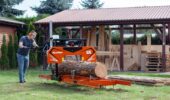
New personal bandsaw mill from Norwood Sawmills
Apr. 24, 2013, Buffalo, NY - Norwood Sawmills, a global portable sawmill and forestry equipment manufacturer, has introduced a newly designed, personal bandsaw mill. The next-generation LumberMate LM29 portable sawmill, based on the successful Norwood LumberLite ML26, is the next evolution in personal bandmills. With beefed-up capacity, the new LM29 can handle logs up to 29" (72.5cm) in diameter. Its throat opening has also been increased by over 40%, giving the LM29 the power to mill lumber up to 24" (60cm) wide. An adjustable guide system has been added to provide maximum blade support through both wide and narrow cuts. Finally, the range of engines available to power this particular model has been increased to include a 16hp V-Twin Briggs Vanguard electric-start engine, in addition to 9hp, 13hp and 14hp recoil-start engines. Norwood Sawmills' President, Ashlynne Dale points out, "With bigger capacity and greater functionality, the LM29's additional utility answers a broader range of sawmilling needs. It will give Norwood's global customers affordable access to a versatile mobile bandsaw, capable of milling substantially-sized softwood and hardwood logs, while remaining exceptionally easy to use and maintain." Like its predecessor, the LumberMate LM29 boasts a useful line-up of optional add-on attachments, including log deck extensions to mill longer lumber, a trailer system to tow the sawmill to remote milling sites, toe boards to compensate for log taper, log loading winches and ramps to simplify log loading and rotating, and Norwood's patented auto-lube system, among others. With so many attachments to add over time, the mill is capable of expanding as customers' sawmilling needs do. "Given the increased size and utility of the LM29," continues Dale, "it has earned the right to bear Norwood's flagship sawmill brand name 'LumberMate' a name which is synonymous with premium-quality, reliability and versatility to sawyers all around the world." "The LumberMate LM29 is an exceptionally capable sawmill, which outperforms all others in its class. It's engineered to cut lumber faster and more easily, which means higher production for Norwood owners," concludes Dale, "And, given its incredibly low purchase price, the LM29 is perfect for hobbyists, first-time sawyers and even custom sawyers." For more information on Norwood Sawmills, visit http://www.norwoodsawmills.com/.
Automation continues to find its way into the filing room as demands for greater efficiency and speed – and a looming labour shortage – continue.
Maintenance
Saw filing automation
Automation continues to find its way into the filing room as demands for greater efficiency and speed – and a looming labour shortage – continue.
After two years of research and development in both Europe and North America, Cut Technologies has designed a tipping machine perfectly suited for the North American sawmill filing room.